Victorian literature is one of the most fascinating periods in English literary history because it emerged during an age of extraordinary change.
Victorian Age Literature: History, Themes, Characteristics, and Major Writers
Britain was becoming increasingly industrialized, cities were expanding, science was challenging traditional beliefs, and sharp divisions existed between social classes. Writers responded to these changes by creating works that explored poverty, ambition, morality, love, identity, social injustice, and the complicated nature of human life.
But what makes Victorian literature so important? To understand it, we need to look beyond famous novels and poems and examine the society that produced them.
What Era Was Victorian?
The Victorian era refers to the period of Queen Victoria’s reign, which lasted from 1837 to 1901. Therefore, the Victorian era years are generally considered to be 1837–1901.
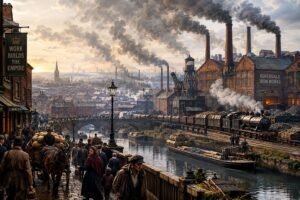
The period sits between the Romantic and Modern periods of English literature. While Romantic writers often emphasized imagination, emotion, and nature, Victorian writers became increasingly interested in society, realism, morality, science, and everyday human experience.
The Victorian age in English literature was therefore not simply a period of novels and poetry. It was a literary response to a rapidly changing world.
History of Victorian Age Literature
The history of Victorian age literature is closely connected with the dramatic transformation of nineteenth-century Britain.
The Industrial Revolution changed how people worked and where they lived. Large numbers of people moved to cities in search of employment, while factories and new industries generated enormous wealth. At the same time, many workers experienced poverty, unsafe working conditions, overcrowded housing, and exploitation.
These contradictions became important subjects for writers.
Charles Dickens, for example, used fiction to expose poverty and social injustice. Elizabeth Gaskell examined industrial communities and relationships between different social classes. George Eliot explored morality, relationships, education, religion, and the complicated motivations of ordinary people.
Science also transformed Victorian thinking. New discoveries, particularly theories associated with Charles Darwin, encouraged people to reconsider traditional ideas about religion, creation, and humanity.
As a result, the literature of Victorian period frequently contains a sense of uncertainty: people were living in a modernizing world while still holding many traditional beliefs.
The Victorian Class System
The Victorian class system strongly influenced everyday life and literature. Victorian society was divided into broad social groups, including the upper class, middle class, and working class.
The Victorian era class system affected education, employment, marriage, wealth, housing, manners, and social opportunities.
Literature often placed characters from different classes together to reveal these inequalities. A person’s social position could determine whom they could marry, where they could live, what education they could receive, and how others treated them.
This is one reason Victorian novels contain so many stories about social ambition, poverty, inheritance, marriage, reputation, and class mobility.
Characteristics of Victorian Age Literature
The characteristics of Victorian age literature developed from the social and intellectual pressures of the period.
1. Realism
One of the most important features of Victorian writing is realism. Writers attempted to portray recognizable people and social situations rather than relying entirely on idealized worlds.
Victorian novels often describe streets, houses, factories, schools, workplaces, families, and communities in remarkable detail.
2. Social Criticism
Victorian writers frequently used literature as a means of examining social problems.
Poverty, child labor, poor education, exploitation, inequality, and the treatment of the working class appear repeatedly in Victorian fiction.
The novel became more than entertainment; it could also encourage readers to question the society around them.
3. Conflict Between Science and Religion
The nineteenth century witnessed major scientific developments. These developments sometimes challenged established religious beliefs.
Consequently, Victorian poetry and fiction often explore faith, doubt, science, morality, and humanity’s search for meaning.
4. Class and Social Mobility
Class is one of the defining concerns of Victorian period literature. Characters frequently struggle against social limitations or attempt to improve their position.
Money and social status could influence relationships, marriage, education, and personal opportunities.
5. Morality and Responsibility
Victorian society placed considerable emphasis on moral behavior. Literature consequently explores questions of right and wrong, duty, guilt, responsibility, temptation, and redemption.
Many characters face difficult moral choices rather than simple battles between good and evil.
6. The Position of Women
Victorian writers also examined women’s roles in family and society.
Marriage, education, economic independence, domestic expectations, and women’s desire for greater freedom became important literary subjects. Writers such as Charlotte Brontë and George Eliot created complex female characters who challenged conventional expectations in different ways.
7. Psychological Complexity
Victorian writers became increasingly interested in what happens inside the human mind.
Characters experience jealousy, guilt, ambition, fear, loneliness, love, disappointment, and moral conflict. This psychological depth helped make Victorian fiction especially memorable.
8. Gothic Influence
The Gothic tradition remained influential throughout the period. Mystery, darkness, supernatural possibilities, secret identities, and psychological fear can be found in several important Victorian works.
Robert Louis Stevenson’s The Strange Case of Dr Jekyll and Mr Hyde is an excellent example of how Victorian literature could combine Gothic fiction with questions about human nature and morality.
9. Detailed Storytelling
Victorian novels are often lengthy and richly detailed. Writers developed large casts of characters, complicated plots, multiple settings, and interconnected storylines.
This allowed them to present an entire picture of society rather than focusing only on one individual.
Major Victorian Period Writers
The Victorian period writers produced some of the most enduring works in English literature.
Charles Dickens
Dickens is perhaps the most recognizable Victorian novelist. His works explore poverty, childhood, class inequality, crime, education, family, and social injustice.
Important works include:
- Oliver Twist
- David Copperfield
- Great Expectations
- A Tale of Two Cities
- Hard Times
Charlotte Brontë
Charlotte Brontë’s Jane Eyre combines romance, social criticism, personal independence, morality, and psychological development. Jane’s struggle for dignity and independence makes the novel particularly significant.
George Eliot
George Eliot, the pen name of Mary Ann Evans, is celebrated for her psychological insight and realistic portrayal of society.
Her major work Middlemarch examines marriage, ambition, politics, education, morality, and social expectations.
Thomas Hardy
Hardy’s novels often portray individuals struggling against social restrictions, circumstances, and forces beyond their control.
Important works include:
- Tess of the d’Urbervilles
- Jude the Obscure
- The Mayor of Casterbridge
- Far from the Madding Crowd
Elizabeth Gaskell
Gaskell explored industrial society, class divisions, family relationships, and the experiences of working communities.
Her novel North and South is particularly valuable for understanding Victorian attitudes toward industrialization and class.
Robert Louis Stevenson
Stevenson brought Gothic suspense and psychological conflict together in works such as The Strange Case of Dr Jekyll and Mr Hyde.
Oscar Wilde
Wilde represents another side of Victorian literature. His writing is known for wit, satire, aestheticism, and criticism of social hypocrisy.
His famous novel The Picture of Dorian Gray explores beauty, morality, corruption, and identity.
Important Victorian Age Works
The Victorian age works cover an extraordinary range of genres and subjects.
Some particularly important examples include:
| Writer | Major Work | Important Themes |
|---|---|---|
| Charles Dickens | Great Expectations | Class, ambition, identity |
| Charles Dickens | Oliver Twist | Poverty, childhood, social injustice |
| Charlotte Brontë | Jane Eyre | Independence, love, morality |
| George Eliot | Middlemarch | Society, marriage, ambition |
| Thomas Hardy | Tess of the d’Urbervilles | Society, fate, morality |
| Elizabeth Gaskell | North and South | Class, industry, social conflict |
| Robert Louis Stevenson | Dr Jekyll and Mr Hyde | Duality, morality, identity |
| Oscar Wilde | The Picture of Dorian Gray | Beauty, corruption, morality |
Victorian Poetry
Victorian literature was not limited to the novel. Poetry also flourished during the period.
Alfred Lord Tennyson became one of the most important Victorian poets. His poetry frequently addresses grief, faith, doubt, death, nature, heroism, and the changing intellectual climate of the nineteenth century.
Robert Browning became famous for dramatic monologues, allowing readers to explore the minds and personalities of individual speakers.
Matthew Arnold often expressed the uncertainty and spiritual doubt of the Victorian age, particularly in poems such as Dover Beach.
The period also saw important developments in women’s poetry, aestheticism, and later nineteenth-century literary experimentation.
Why Is Victorian Literature Still Important?
The continuing popularity of Victorian period literature is not accidental. Many of the problems Victorian writers explored remain relevant today.
Questions about wealth and poverty, social class, gender, work, education, morality, identity, technology, and social change continue to shape modern society.
Victorian writers also demonstrated that literature can do more than tell a story. It can make readers question their assumptions, understand other people’s experiences, and examine the society in which they live.
Conclusion
Victorian literature is best understood as the literature of a society caught between tradition and modernity. The period witnessed industrial expansion, scientific discovery, urbanization, changing social structures, and growing debates about religion and morality.
These changes shaped the novels, poetry, and drama of the period and produced writers whose works remain widely read.
From Dickens’s social criticism to Brontë’s exploration of independence, Eliot’s psychological realism, Hardy’s tragic vision, and Wilde’s satire, Victorian literature presents a remarkably diverse picture of nineteenth-century life.
Finally, the greatest strength of Victorian literature is its ability to turn the problems of one historical period into questions that still speak to readers today.