Introduction
What Is Victorian Period Poetry?
Victorian poetry refers to the poetry written during the Victorian era (1837–1901), the period when Queen Victoria ruled Britain. It developed during a time of rapid industrialisation, scientific progress, social change, and expanding cities. Meanwhile, Victorian poets acquired different poetic characteristics. Victorian poets often explored the tension between faith and doubt, tradition and modernity, nature and industrial society, and individual emotions and social responsibilities. The Victorian era can be seen as a symbol of the beginning of Materialism and Realism.
One of the most important Victorian poets was Alfred, Lord Tennyson, whose poems “In Memoriam A.H.H., “The Lady of Shalott,” and “Ulysses” reflect grief, faith, doubt, heroism, and the search for meaning. Robert Browning introduced a new characteristic of Victorian poetry in the form of dramatic monologue; he became famous for the technique. His dramatic monologues, such as “My Last Duchess” and “Porphyria’s Lover, ” reveal the psychology of their speakers. Matthew Arnold, in “Dover Beach,” expressed the anxiety created by declining religious certainty and changing society.
Other notable Victorian poets include Christina Rossetti, known for “Goblin Market” and “Remember,” and Gerard Manley Hopkins, whose “God’s Grandeur” combines religious themes with innovative poetic language and rhythm. Elizabeth Barrett Browning, another major voice, explored love and social concerns in “Sonnets from the Portuguese.” Moreover, Victorian poetry combines romantic emotion, social criticism, religious questioning, moral concerns, and reflections on a rapidly changing world.
Major Themes of Victorian Poetry
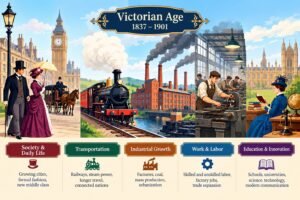
Victorian poetry reflects the intellectual, social, religious, and emotional tensions of the nineteenth century. As Britain experienced industrialisation, scientific discoveries, urban growth, and changing social values, poets responded to these transformations through different themes.
1. Faith, Doubt, and Religious Crisis
One of the most important themes of Victorian poetry is the conflict between religious faith and growing doubt. Scientific developments and new intellectual ideas challenged traditional beliefs.
Matthew Arnold’s “Dover Beach” presents a world in which the “Sea of Faith” appears to be retreating. The poem expresses anxiety about the loss of certainty and spiritual security.
Similarly, Alfred, Lord Tennyson’s “In Memoriam A.H.H.” explores grief, faith, and doubt following the death of his close friend Arthur Hallam. Tennyson questions the relationship between God, nature, suffering, and human existence while gradually searching for renewed faith.
2. Industrialisation and Social Change
The Industrial Revolution transformed Victorian society, creating enormous cities, factories, and new social problems. Victorian poets often responded to the effects of this transformation.
In William Blake’s “London”—although Blake belongs to the earlier Romantic period—the poem is an important precursor to Victorian social criticism, portraying poverty, oppression, and suffering in an urban environment.
Among Victorian poets, Elizabeth Barrett Browning’s “The Cry of the Children” directly addresses the suffering of child labourers. The poem criticises social conditions in which children are forced to work rather than enjoy childhood.
3. Nature and Its Relationship with Humanity
Nature remained an important subject, but Victorian poets often presented it differently from earlier Romantic poets. Nature could provide beauty and spiritual meaning, but it could also appear indifferent or mysterious.
Tennyson’s “In Memoriam A.H.H.” questions why a beautiful natural world can exist alongside death and suffering. The poem therefore connects nature with the larger Victorian struggle between faith and doubt.
In Gerard Manley Hopkins’s “God’s Grandeur,” nature becomes evidence of divine power. Hopkins celebrates the presence of God in the natural world while also expressing concern about humanity’s destructive relationship with nature.
4. Love, Loss, and Grief
Personal emotion is another central feature of Victorian poetry. Love is frequently connected with separation, death, memory, and longing.
Tennyson’s “In Memoriam A.H.H.” transforms personal grief into a broader meditation on mortality and faith.
Christina Rossetti’s “Remember” explores love, separation, and death, asking the beloved to remember her but ultimately placing the other person’s happiness above remembrance.
5. Death and Mortality
Victorian poets frequently reflected on death, partly because of personal loss and partly because the period was marked by intense religious and scientific questioning.
Tennyson’s “In Memoriam A.H.H.” is one of the clearest examples. The death of Hallam becomes the starting point for questions about human mortality, divine purpose, and the possibility of immortality.
Rossetti’s “Remember” similarly treats death not simply as an ending but as an experience that affects those who remain alive.
6. The Individual and Psychological Conflict
Victorian poetry often examines the complexity of the human mind. Robert Browning was particularly famous for the dramatic monologue, allowing a character to reveal his personality through speech.
In “My Last Duchess,” Browning presents a powerful duke whose words gradually reveal his controlling and possessive personality. The poem demonstrates how Victorian poetry could explore psychology, power, jealousy, and morality through a single dramatic speaker.
7. Social Problems and Injustice
Victorian poets did not limit themselves to personal emotions; many addressed poverty, exploitation, inequality, and the treatment of vulnerable people.
Elizabeth Barrett Browning’s “The Cry of the Children” protests against child labour and gives poetic expression to the suffering of working children. Her poetry demonstrates how Victorian literature could become a vehicle for social criticism.
8. Science and Modernity
The Victorian period witnessed extraordinary advances in science, technology, transportation, and industry. These developments created both excitement and uncertainty. Tennyson’s poetry often reflects this tension. In “Locksley Hall,” for example, the speaker imagines a rapidly developing future while also struggling with personal disappointment and social change. Victorian poetry therefore does not simply celebrate progress; it frequently asks what humanity might lose while pursuing it.
The major themes of Victorian poetry include faith and doubt, industrialisation, social injustice, nature, love, grief, death, psychological conflict, and the challenges of modernity. Poets such as Tennyson, Browning, Arnold, Rossetti, Barrett Browning, and Hopkins responded differently to the problems of their age, but their works collectively capture a society caught between traditional beliefs and a rapidly changing modern world.
Some Common Characteristics of Victorian Poetry: A Comparison with the Romantic Age
Victorian period was the era of Queen Victoria, who ruled from 1837 to 1901. It was the age when industrialisation and human advancements were in the early stages. So, most of the authors curiously wrote and included the characteristics of industrialisation and technology, Science, Medicine, and exploration. Victorian poetry developed after the Romantic Age and retained some Romantic characteristics also, while responding to a very different social and intellectual environment. Romantic poets such as William Wordsworth, Samuel Taylor Coleridge, Lord Byron, Percy Bysshe Shelley, and John Keats emphasised imagination, emotion, individual experience, and the beauty of nature. Victorian poets such as Alfred, Lord Tennyson, Robert Browning, Matthew Arnold, Christina Rossetti, and Gerard Manley Hopkins continued some of these characteristics but increasingly addressed social change, scientific thought, religious doubt, and the complexities of modern life.
1. Nature: Spiritual Refuge vs. Complex Reality
Nature has been the prime characteristic because it is a source of inspiration, beauty, spiritual comfort, and personal renewal. Wordsworth’s “Tintern Abbey” shows the poet’s deep emotional and spiritual relationship with nature. Victorian poets continued to write about nature but often treated it more cautiously. In Tennyson’s “In Memoriam A.H.H.”, nature is beautiful but can also appear indifferent to human suffering. Hopkins’s “God’s Grandeur,” however, presents nature as a manifestation of divine power.
2. Imagination and Emotion vs. Reason and Reflection
Romantic poetry strongly values imagination and spontaneous emotional experience. Keats’s “Ode to a Nightingale” uses imagination to move beyond ordinary reality, while Shelley’s “To a Skylark” celebrates imaginative freedom. Victorian poetry often combines emotion with intellectual reflection. Tennyson’s “In Memoriam A.H.H.” begins with personal grief but develops into an extended examination of faith, science, death, and human existence. Victorian poetry tends toward the objective form of poetry rather than the subjective form as Romantic authors did.
3. Individualism and Social Responsibility
Romantic poets frequently emphasise the individual, personal freedom, and the imagination. Byron’s “Childe Harold’s Pilgrimage” presents a strongly individualistic and reflective figure. Victorian poets increasingly connected individual experience with society. Elizabeth Barrett Browning’s “The Cry of the Children” focuses on child labour and social suffering, showing how poetry could address contemporary social problems.
4. Romantic Idealism vs. Victorian Realism
Romantic poetry often idealises beauty, imagination, freedom, and the natural world. Keats’s “Ode on a Grecian Urn” explores idealised beauty and art. Victorian poetry frequently presents a more complicated picture of reality. In Browning’s “My Last Duchess,” the speaker’s elegant language gradually reveals disturbing aspects of his personality. The poem demonstrates the Victorian interest in psychological complexity and moral ambiguity.
5. Faith and Religious Doubt
Romantic poets certainly explored religion and spirituality, but Victorian poetry was particularly influenced by the intellectual crisis of the nineteenth century.
In Arnold’s “Dover Beach,” the retreat of the “Sea of Faith” symbolises uncertainty about traditional religious belief. Tennyson’s “In Memoriam A.H.H.” similarly moves between doubt and the desire for faith.
6. Response to Industrialisation
Romantic poetry emerged partly as a response to early industrial and social changes, often celebrating rural landscapes and natural life. Victorian poets lived in a more extensively industrialised society and directly confronted its consequences. Barrett Browning’s “The Cry of the Children” highlights the suffering associated with industrial labour and social inequality.
7. Medievalism and Historical Interest
Both periods showed interest in the past, but Victorian poets frequently used medieval subjects to explore contemporary concerns.
Tennyson’s “The Lady of Shalott” draws on a medieval-style setting while exploring isolation, art, love, and the relationship between the individual and society.
8. New Poetic Forms and Techniques
Romantic poets experimented with lyric poetry, ballads, odes, and dramatic forms. Victorian poets continued this experimentation while developing distinctive techniques. Browning’s dramatic monologues, particularly “My Last Duchess,” give readers access to a character’s mind through speech. Hopkins developed innovative rhythms and sound patterns in poems such as “God’s Grandeur.”
Conclusion
The difference between Romantic and Victorian poetry can be understood as a movement from imagination, nature, individual emotion, and idealism toward a broader engagement with social reality, intellectual uncertainty, psychological complexity, and modern life. However, Victorian poets did not completely reject Romanticism. They introduced new characteristics of Victorian Poetry, expressing nature, emotion, imagination, and individual experience while adapting these trends to a rapidly changing nineteenth-century world.