Introduction
Emily Dickinson wrote the poem Hope is the thing with feathers around 1861. This poem was in the collection of Dickinson’s poems known as Second Series in 1891. The collection of poems appeared after her death.
Historical Background
1861 was the time when the Civil War broke out in America. This created widespread uncertainty, fear, separation, and loss. Dickinson lived in Amherst, Massachusetts, and although she did not serve as a soldier or participate directly in the war, she was not completely isolated from national events. Her correspondence and poetry show an awareness of the world around her. You can also read the poem ” Hope is a thing with feathers ” in the following image
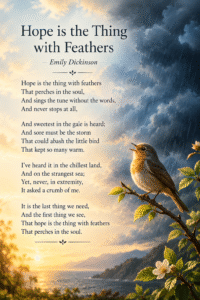
However, it is important not to assume that the poem was specifically written about the Civil War. There is no clear evidence that Dickinson composed this poem Hope is the thing with feathers as a direct response to the war. The storm, cold, and difficult conditions in the poem can instead be understood more broadly as metaphors for human suffering and adversity. The circumstances were adverse and uncertain for common people; suffering, uncertainty, and domestic turmoil were rife at the time of civil war.
Around this period, Dickinson was writing many poems, including ” Hope is a thing with feathers, and organising her works into small handmade booklets called fascicles. She lived primarily at her family home in Amherst and developed a highly distinctive poetic style characterised by short lines, unusual punctuation, slant rhyme, and compressed imagery.
Full Summary of the poem “Hope is the Thing with Feathers by Emily Diskinson”
Hope is the Thing with Feathers by Emily Dskinson is a short but powerful poem about the strength, persistence, and comfort of hope. Dickinson uses the image of a bird to represent hope and explains how it continues to support people through difficult experiences.
At the beginning of the poem, Dickinson compares hope to “ a thing with feathers.” This immediately creates the image of a small bird, though it may be unknown. The bird represents hope because a bird shows a sign of freedom, as hope also shows a sign of freedom. When someone has hope, he/she can feel comfort and relax. It exists quietly within a person and can remain immune from anguish. Dickinson says that this bird has its home in the soul, suggesting that hope is an inner human quality rather than something that depends entirely on the outside world.
The bird continuously sings its song. This song represents the encouragement and comfort that hope also provides. As, the bird does not need words to communicate its message. Hope can exist even when a person cannot clearly explain what they are feeling or what they expect from the future.
Dickinson then introduces the image of a storm. The storm symbolises the hardships, trouble, suffering, disappointments, and challenges that people experience in life. Even when the storm becomes powerful and frightening, the bird of hope continues singing and consoling people. This shows that genuine hope can remain alive even during severe, difficult circumstances. The thing wifeatherssher vividly crean imageation of a bird in the minds of readers. Becau, feather reprent a thing having its own support and power. It is obvious that when birds fly, they use feathers to provide them power and make them feel relaxed. Likewise, Hope is soft like a bird that makes us feel comforted and powerful.
The poet also describes the bird’s song as particularly powerful because it can be heard in difficult situations. Hope does not disappear simply because circumstances become worse. Instead, adversity can reveal how persistent hope really is. The contrast between the harsh storm and the gentle singing bird emphasises the strength of the human spirit.
In the final part, Dickinson explains that hope has helped people during extremely difficult situations. She describes circumstances so severe that even the coldest or most dangerous conditions could not silence the bird. Yet hope never demanded anything in return. It gives comfort freely and selflessly, without asking for payment or reward.
In last,
Emily Dickinson’s poem ” Hope is a thing with feathers presents hope as an enduring force within the human soul. Through the extended metaphor of a bird, Dickinson shows that hope can provide comfort, courage, and emotional strength during hardship. The bird continues singing regardless of the storm, just as hope can continue to exist even when life becomes difficult.
The central message of Emily Dickinson’s poem ” Hope is the thing is that hope may be quiet and delicate, but it possesses remarkable strength and endurance. It can survive suffering, encourage people through adversity, and ask nothing in return.